New evidence on the psychometric performance of the Brief Social Anomie Scale (SAS-10) in post-pandemic Peruvian adults
Nuevas pruebas sobre el rendimiento psicométrico de la Escala Breve de Anomía Social (SAS-10) en adultos peruanos tras la pandemia.
 ,
Lindsey W. Vilca
2
Tomás Caycho-Rodríguez
3,
,
Lindsey W. Vilca
2
Tomás Caycho-Rodríguez
3,
Abstract
The study of social anomie has gained relevance in recent years, and having a scale that quickly and appropriately measures this construct is necessary. In light of this, the objective of the present study was to study the psychometric functioning of the SAS-10 scale in a community population in Peru. The study involved 957 adults of both sexes (75.1% women and 24.9% men) between 18 and 68 years old. The Brief Social Anomie Scale (SAS-10) and Mental Health Inventory-5 (MHI-5) were used. The study results showed that the two-dimensional related model presented a better psychometric functioning (χ2 = 207.86; df = 34; p < .01; RMSEA = .073 [IC90% .064 – .083]; SRMR = .045; CFI=.98; TLI=.98) than the Bi-factor model. Furthermore, this model showed evidence of being strictly invariant according to the sex and age of the participants. Also, a partial relationship was found between the dimensions of mental health and the dimensions of social anomie. It is concluded that the SAS-10 scale presents a robust psychometric performance and is therefore suitable for measuring social anomie in a community population, considering specific sex and age groups.
Keywords: Social Anomia; Mental Health; Adults; Confirmatory Factor Analysis; Factorial invariance
Resumen
El estudio de la anomia social ha cobrado relevancia en los últimos años, por lo que es necesario contar con una escala que mida este constructo de forma rápida y adecuada. En vista de ello, el objetivo del presente estudio fue analizar el funcionamiento psicométrico de la escala SAS-10 en una población comunitaria de Perú. En el estudio participaron 957 adultos de ambos sexos (75,1 % mujeres y 24,9 % hombres) de entre 18 y 68 años. Se utilizaron la Escala Breve de Anomia Social (SAS-10) y el Inventario de Salud Mental-5 (MHI-5). Los resultados del estudio mostraron que el modelo bidimensional relacionado presentaba un mejor funcionamiento psicométrico (χ2 = 207,86; df = 34; p < 0,01; RMSEA = 0,073 [IC90 % 0,064 – 0,083]; SRMR = 0,045; CFI = 0,98; TLI = 0,98) que el modelo bifactorial. Además, este modelo mostró evidencia de ser estrictamente invariante según el sexo y la edad de los participantes. Asimismo, se encontró una relación parcial entre las dimensiones de salud mental y las dimensiones de anomia social. Se concluye que la escala SAS-10 presenta un rendimiento psicométrico robusto y, por lo tanto, es adecuada para medir la anomia social en una población comunitaria, teniendo en cuenta grupos específicos de sexo y edad.
Palabras Clave: Anomia social; Salud mental; Adultos; Análisis factorial confirmatorio; Invarianza factorial
1. INTRODUCTION
During the COVID-19 pandemic, the world's population underwent a change at social, economic, and health levels (Rahman et al., 2021; Dai et al., 2021; Valencia, 2020). During this period, some people experienced helplessness and loss of autonomy as their daily routines were altered, further aggravated by financial and mental distress due to daily information on the morbidity and mortality of the disease (Powell et al., 2021). In this context, not all people respected the rules implemented to prevent the spread of the pandemic (Roblain et al., 2022; Abrutyn, 2021; Drury, 2022). This phenomenon is known as social anomie, which could be explained by the need to satisfy needs in the social, emotional, sexual, economic, and health aspects, turning these demands into actions to evade social norms (Cueto & Viotti, 2020). Social anomie has been characterized by social destabilization, unrest, and social distrust during the pandemic. Social destabilization and unrest indicate the presence of discrepancies, inconsistencies, and the lack of laws that generate confusion and destabilization at the social level. This problem would lead to a lack of confidence in applying precautionary measures against COVID-19 (Halvaiepour & Nosratabadi, 2021). This behavior of going against imposed social norms is more common in more vulnerable populations (Lázaro-Aquino, 2021).
Failure to comply with the rules during the pandemic led to an increase in the mortality rate in the population due to constant exposure to the virus (Brenner & Bhugra, 2020; De Sousa, 2021). Brazil was one of the countries where most people did not comply with health regulations to prevent contagion, which caused this country to have the highest mortality rate in Latin America (Malamud & Núñez, 2020). Similarly, in Cuba, during the pandemic, the majority of the people rejected the imposition of regulations to prevent contagion since these prevented the daily development of activities carried out by the population, thus increasing the number of infections and, with it, an increase in the mortality rate (Hernández et al., 2022). This behavior also occurred in Chile, as the emergence of COVID-19 intensified social anomie behavior in people due to dissatisfaction and resentment against the new measures implemented by the government, expressed in violent actions, such as looting and vandalism, among other actions that brought the country to the brink of institutional danger (Guerrero & Pérez, 2020). This behavior also caused more infections and deaths (Linn et al., 2021).
Ecuador went through a similar situation because social anomie during the state of emergency generated severe social dysfunction, as the most vulnerable people, socially and economically, considered it necessary to go against the new norms to satisfy their basic needs (Padilla, 2020). These anomic behaviors also caused an increase in the mortality and contagion rate (León & Vaca, 2021). In the same context, in Bolivia, there was a continuous increase in infections and deaths because the population, due to economic necessity, was motivated to disobey the confinement measures imposed by the government to stop the spread of COVID-19, with many people joining informal jobs (Birbuet, & López, 2020; Cardona et al., 2020). In the same sense, the Argentine government prohibited routine activities due to the progressively increasing infections, resulting in the defiance of norms and laws and constant rebellious behavior by people at the individual and collective levels, causing more infections and deaths (Maisley, 2022). Peru was not immune to these social conditions, where the implementation of restrictive measures affected people economically and socially, generating progressive discontent in the vast majority and adding to the need to obtain essential resources, causing non-compliance with the new norms established by the country. All of this increased the rate of infections and deaths (Caycho, 2021).
On the other hand, women have been the most affected group during the COVID-19 pandemic, as the rates of violence against women increased, where, in many cases, the victim, due to restrictive health measures, was forced to live with her aggressor. Also, in this group, the number of unwanted pregnancies, greater psychiatric medication, and suicide attempts increased (Saletti-Cuesta & Aizenberg, 2022; Guil, 2023; Narváez & Acosta-Ramirez, 2022; Cisneros & Yautentzi, 2021). Regarding young people, this group presented higher levels of social anomie, negative affect, and frustration compared to adults. In addition, they presented greater maladaptive behaviors against social norms, such as getting involved in strikes, marches, sit-ins, or even actions considered criminal. This problem could partly be explained by perceived inequality and hopelessness (Barrera et al., 2022). On the other hand, the experience of high expectations in people can produce an anomic pathology because, by not having met these expectations, the degree of anguish and frustration in individuals is generated and intensified, being a contributing factor in the increase in the number of young people who experience higher levels of anxiety and depression (Jacobsen & Nørup, 2020).
These findings confirm that psychological, emotional, cultural, and social conditions determine people's mental state. The COVID-19 pandemic caused people to be directly affected by situations of socioeconomic deprivation and constant social confusion, altering their daily methods of living in the face of a government that does not adjust to their objectives and needs, which motivates them to have defiant behavior and rejection of the social norms established by the States (Cisneros & Yautentzi, 2021; Lantz, 1986; Lantz & Harper, 1989). In relation to this, several studies claim that social anomie is related to depression and stress (Lantz & Harper, 1990; Reinarman et al., 2000).
Consequently, stressors and their influence at a social level negatively intervene in people's mental health, contributing to the increase in anxiety and depression, in addition to suicide. Among other psychological problems, such as post-traumatic stress due to the significant impact of anomie (Larizgoitia et al., 2004; Madariaga, 2019). That is, the different ways of perceiving and developing in society are related to depression. Situations influenced by social anomie result in behaviors that go against norms and laws (Blanco & Díaz, 2006). Therefore, there has been a progressive increase in social anomie due to the needs and aspirations that people have, negatively impacting their mental health, which generates an evident deviation in behavior; this is greater for those who experience social anomie directly (Villegas, 2020).
Faced with this problem, it is important to measure social anomie adequately, and only one instrument has been found to measure this construct (Vilca et al., 2022). The Social Anomie scale (SAS-10) presents ten items that form a Bi-factor model, a model made up of two factors (behavioral and affective) and a general factor. The behavioral factor refers to the lack of compliance with norms and laws. In contrast, the affective factor refers to the degree of dissatisfaction, discomfort, or concern generated by the norms and laws implemented by the government (Halvaiepour & Nosratabadi, 2021; Roblain et al., 2022). The SAS-10 scale presented adequate initial evidence of reliability (ωH=.70) and validity based on the internal structure (χ 2=62.86; df=25; p=.000; CFI=.99; TLI=.99; WRMR=.52; RMSEA=.061 [IC90% .042-.080]) (Vilca et al., 2022). The psychometric properties of the SAS-10 scale have been studied in twelve Latin American countries, where the model that best fit in most countries was a model with two related dimensions, specifically in Peru, where the model presented adequate fit indices (χ 2=43.11; df=25; p=.014; CFI=.99; TLI=.99; SRMR=.026; RMSEA=.060 [IC90% .027-.089]) (Caycho-Rodríguez, et al., 2023).
These results show a discrepancy regarding Peru's factorial structure of the SAS-10 scale. In addition, the instrument shows some limitations, such as the lack of evidence on the factorial invariance of the scale. This evidence is crucial because it allows for more accurate interpretations of the differences found when comparing between groups (Caycho, 2017; Caycho, 2019). Also, no evidence has been shown of validity based on the relationship with other variables. This evidence would allow the comparison of the variable studied with other variables and to analyze whether the scores derived from the scale are related to other variables (Balkin, 2017).
Therefore, this research aims to study the psychometric functioning of the SAS-10 scale in a community population in Peru. In addition, it aims to evaluate the impact of social anomie on mental health indicators, such as anxiety and depression.
2. METHODS
Participants
Table 1 shows that 957 young people and adults between 18 and 30 (75.5%) and 30 to 68 (24.5%) participated in the study, of which 75.1% were women and 24.9% were men. It is also noted that most of the participants come from the coast (53.8%), live with their family of origin (60.3%) and are single (72.6%). In addition, it is observed that 38.8% only study and 29.6% study and work simultaneously. For this research, a non-probabilistic convenience sampling was used, and the following inclusion criteria were used: (a) be of legal age, (b) give informed consent, (c) be Peruvian, and (d) know how to read and write.
Table 1: Sociodemographic data of participants
| n | % | |
|---|---|---|
| Sex | ||
| Male | 238 | 24.9% |
| Female | 719 | 75.1% |
| Age | ||
| From 18 to 30 years old | 723 | 75.5% |
| From 31 to 68 years old | 234 | 24.5% |
| Origin | ||
| Coastal region | 515 | 53.8% |
| Mountain region | 334 | 34.9% |
| Jungle region | 108 | 11.3% |
| Live with | ||
| Nuclear family (husband(wife) and children) | 260 | 27.2% |
| Family of origin (father, mother, siblings and other relatives) | 577 | 60.3% |
| With friends | 22 | 2.3% |
| Alone | 98 | 10.2% |
| Occupation | ||
| Working | 251 | 26.2% |
| Studying | 371 | 38.8% |
| Both | 283 | 29.6% |
| None | 52 | 5.4% |
| Marital status | ||
| Single | 695 | 72.6% |
| Married | 119 | 12.4% |
| Living Together | 124 | 13.0% |
| Divorced | 19 | 2.0% |
Measures
Brief Scale of Social Anomie (SAS-10)
In the present study, the Brief Social Anomie Scale (SAS-10) was used to study the presence of social anomie indicators (Vilca et al., 2022). The scale comprises ten items representing two dimensions: Affective (items from 1 to 5) and Behavioral (items from 6 to 10). In addition, all items have four response categories: Strongly disagree (0), Disagree (1), Agree (2), and Strongly agree (3). The scale does not present inverse items; therefore, a higher score shows a greater presence of social anomie at a general level. Specific scores can also be obtained for each dimension since the model underlying the test is a Bi-factor model. In the original study, the scale's internal structure showed adequate fit indices (χ2=62.86; df=25; p=.000; CFI=.99; TLI=.99; CFI=.99; WRMR=.52; RMSEA=.061 [IC90% .042-.080]). In addition, it showed adequate internal consistency indices (ωH=0.70) (Vilca et al., 2022).
Mental Health Inventory-5 (MHI-5)
It was developed by Berwick et al. (1991) and adapted to Spanish by Rivera-Riquelme, Piqueras, and Cuijpers (2019). The present study's version adapted to Peru presented robust evidence of its unidimensional factor structure (χ2=24.03; df=4; p=.000; CFI=.99; TLI=.99; CFI=.99; RMSEA=.071 [IC90% .045-.099]) (Vilca, et al., 2022). The MHI-5 is made up of five items that assess the presence of psychological well-being (items 2 and 4) and psychological distress (reverse items 1, 3, and 5). In addition, the Spanish version has four response categories ranging from "never" (0) to "always" (3), where a higher score indicates better mental health status.
Data analysis
For the Confirmatory Factor Analysis (CFA), the WLSMV estimator was used since the items are at the ordinal level (Brown, 2015). The criteria used to evaluate the model fit were the following: RMSEA (< .08), SRMR (< .08), CFI (> .95), and TLI (> .95) (Kline, 2023; Schumacker & Lomax, 2004). The scale's internal consistency was evaluated through Cronbach's alpha coefficient (Cronbach, 1951) and the omega coefficient (McDonald, 1999). A value greater than .70 was considered adequate (Viladrich et al., 2017). The omega coefficient (McDonald, 1999) was used to evaluate the internal consistency of the scale, where a value greater than .70 is adequate (Viladrich et al., 2017). The H coefficient was also used since it allows us to evaluate how well a latent variable is represented by a set of items (Hancock & Mueller, 2001). Likewise, the hierarchical omega coefficient was also used (Zinbarg et al., 2005). To evaluate the strength of the general factor in the Bi-factor models, the Explained Common Variance was reported (Sijtsma, 2009).
The factorial invariance of the scale according to the age of the participants was evaluated through a sequence of hierarchical variance models: configural invariance, metric invariance, scalar invariance, and strict invariance. The chi-square difference (Δχ2) was used to compare the differences in the sequence of models, where non-significant values (p>.05) suggested invariance between the groups. The differences in the RMSEA (ΔRMSEA) and CFI (ΔCFI) were also taken into account, where differences less than <.015 and <.10, respectively, show the invariance of the model (Chen, 2007).
An SEM model assessed the scale's validity for other variables. In this model, it was hypothesized that the dimensions of mental health are related to the dimensions of social anomie. The WLSMV estimator was used to estimate the model, and the same adjustment indicators used in the CFA were considered. All statistical analyses were performed using the "lavaan" package (Rosseel, 2012) for the CFA and SEM and the "semTools" package (Jorgensen et al., 2018) to perform factorial invariance.
Procedure
The study was approved by the ethics committee of the Faculty of Health Sciences. In addition, the study followed the Helsinki standards (World Medical Association, 2013). A non-probabilistic snowball sampling was used for data collection since it was the most appropriate method to access the participants. A virtual form prepared on the Google Forms platform was used, and it was shared through social networks such as Facebook, WhatsApp, Messenger, and Instagram. In the first phase of the form, the research objectives and informed consent were shown; only people who voluntarily agreed to participate in the study accessed the next section of the form. The second section presented the questions referring to sociodemographic data. Finally, in the third section, the questions of the scales used in the study were shown. It is important to note that people completed the form within five to ten minutes.
3. RESULTS
Descriptive análisis
Table 2 shows the descriptive data for the social anomie scale (SAS-10). The mean score for item 4 was 3.07, the highest score, and the mean score for item 3 was 1.78, the lowest score. Regarding asymmetry and kurtosis, adequate results were found for all items, falling within the range of +/-1.5.
Table 2: Descriptive statistics of the scale items
| Items | M | DE | g1 | g2 | TD | D | A | TA |
|---|---|---|---|---|---|---|---|---|
| 1. Las nuevas normas y/o leyes me causan insatisfacción | 2.66 | .79 | -.13 | -.42 | 6.8% | 34% | 45.8% | 13.5% |
| 2. Me molesta que las nuevas normas y/o leyes no ayuden a quienes más lo necesitan. | 1.98 | .78 | .53 | -.02 | 27.8% | 50.7% | 17.6% | 4.0% |
| 3. Me siento molesto porque las nuevas normas y/o leyes de mi país no me permiten cubrir mis necesidades básicas. | 1.78 | .72 | .76 | .57 | 37.3% | 50.3% | 9.9% | 2.5% |
| 4. Me siento preocupado porque las nuevas regulaciones y/o leyes de mi país afectan mis ingresos económicos. | 3.07 | .87 | -.76 | -.03 | 7.0% | 14.0% | 44.2% | 34.8% |
| 5. Me siento molesto por las nuevas normas y/o leyes establecidas por el gobierno. | 2.05 | .73 | .40 | .03 | 21.5% | 55.2% | 20.1% | 3.2% |
| 6. Eludo las normas y/o leyes para mejorar mis ingresos económicos. | 2.67 | .80 | -.13 | -.45 | 6.9% | 33.5% | 45.2% | 14.3% |
| 7. Cuando quiero algo, no me importa infringir las normas y/o leyes de mi país. | 1.96 | .79 | .60 | .03 | 29.5% | 49.8% | 16.3% | 4.4% |
| 8. Prefiero romper las reglas y/o leyes para que mi situación no empeore. | 2.53 | .81 | -.12 | -.49 | 10.7% | 35.6% | 43.5% | 10.2% |
| 9. No tengo remordimientos por romper las reglas y/o leyes cuando obtengo lo que quiero. | 2.05 | .75 | .48 | .12 | 22.2% | 55.1% | 18.8% | 4.0% |
| 10. Prefiero actuar para obtener lo que necesito independientemente de las regulaciones y/o leyes gubernamentales. | 2.83 | .79 | -.44 | -.10 | 6.5% | 22.6% | 52.8% | 18.2% |
Note. M = Median; SD = Standard deviation; g1 = Asymmetry; g2 = Kurtosis; TD=Totally disagree; D=Disagree; A=Agree; TA=Totally agree
Validity based on internal structure
The study found that the Bi-factor model with two specific factors presents adequate fit indices (χ2 = 126.38; df = 25; p < .01; RMSEA = .065 [IC90% .054 – .077]; SRMR = .029; CFI=.99; TLI=.98). However, a complementary analysis of the Bi-factor model's performance shows that the general factor presents a low ECV (.58), evidencing that the general factor only manages to explain 58% of the variance of the items. Regarding the specific ECV, factor 1 (.29) and factor 2 (.13) manage to explain 29% and 13% of the common variance, respectively. It was also evident that most of the items are not strongly influenced by the general factor (I-ECV < .50). The PUC was equal to .56, which suggests that the general factor explains 56% of the correlations and 44% are contaminated by multidimensionality. The ARPB is equal to .31, indicating that the factor loadings of the bifactor model and the factor loadings of a unidimensional model differ by 31%. The H coefficient is equal to .89, which shows stability in other studies, while the Hs of factor 1 (affect) was greater than .70. This result shows problems in the functioning of the proposed Bi-factor model.
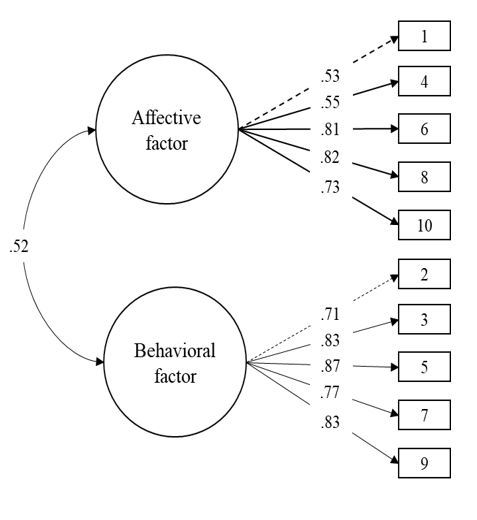
Given these results, other plausible models, such as the two-dimensional model, were studied. The study found that this model presents adequate data fit indices (χ2 = 207.86; df = 34; p < .01; RMSEA = .073 [IC90% .064 – .083]; SRMR = .045; CFI=.98; TLI=.98). Furthermore, it can be seen in Figure 1 that all items have high factorial weights in the factor to which they belong. Both factors are significantly related (.52). Although the Bi-factor model shows slightly higher fit indices than the two-dimensional model, it also has performance problems. Therefore, for the following statistical analyses, the two-dimensional model was chosen.
Factorial invariance according to sex and age
Table 3 shows that the factorial structure of the scale has shown evidence of being strictly invariant between men and women in the sequence of invariance models proposed: metric invariance (ΔCFI = .010; ΔRMSEA = .009), scalar (ΔCFI = .000; ΔRMSEA = -.002) and strict invariance (ΔCFI = .001; ΔRMSEA = .003). Similarly, the scale has shown evidence of measurement invariance across adults aged 18 to 30 and 31 to 68 years: (ΔCFI = -.006; ΔRMSEA = .000), scalar (ΔCFI = -.002; ΔRMSEA = -.001), and strict invariance (ΔCFI = .001; ΔRMSEA = -.003).
Table 3: Invariance indices according to sex and age of participants
| Invariance models | χ2 | df | p | SRMR | TLI | CFI | RMSEA [CI 90%] | Δχ2 | Δdf | p | ΔCFI | ΔRMSEA |
|---|---|---|---|---|---|---|---|---|---|---|---|---|
| Male | 94.07 | 34 | < .001 | .053 | .969 | .977 | .086 [.066 ‒ .107] | ‒ | ‒ | ‒ | ‒ | ‒ |
| Female | 167.94 | 34 | < .001 | .049 | .972 | .979 | .074 [.063 ‒ .085] | ‒ | ‒ | ‒ | ‒ | ‒ |
| Configural | 136.44 | 68 | < .001 | .037 | .947 | .960 | .046 [.035 ‒ .057] | ‒ | ‒ | ‒ | ‒ | ‒ |
| Metric | 126.28 | 76 | < .001 | .039 | .965 | .971 | .037 [.025 ‒ .049] | 6.97 | 8 | .539 | .010 | -.009 |
| Scalar | 135.17 | 84 | < .001 | .040 | .968 | .970 | .036 [.024 ‒ .047] | 8.28 | 8 | .405 | .000 | -.002 |
| Strict | 142.86 | 94 | < .001 | .042 | .973 | .972 | .033 [.021 ‒ .044] | 9.49 | 10 | .485 | .001 | -.003 |
| Adults 18 to 30 | 177.79 | 34 | < .001 | .048 | .970 | .977 | .077 [.066 ‒ .088] | ‒ | ‒ | ‒ | ‒ | ‒ |
| Adults 31 to 68 | 78.92 | 34 | < .001 | .059 | .982 | .987 | .075 [.054 ‒ .097] | ‒ | ‒ | ‒ | ‒ | ‒ |
| Configural | 140.37 | 68 | < .001 | .037 | .943 | .957 | .047 [.036 ‒ .058] | ‒ | ‒ | ‒ | ‒ | ‒ |
| Metric | 157.69 | 76 | < .001 | .044 | .943 | .952 | .047 [.037 ‒ .058] | 15.74 | 8 | .046 | -.006 | .000 |
| Scalar | 169.84 | 84 | < .001 | .045 | .946 | .949 | .046 [.036 ‒ .056] | 10.68 | 8 | .220 | -.002 | -.001 |
| Strict | 178.61 | 94 | < .001 | .047 | .952 | .950 | .043 [.034 ‒ .053] | 11.51 | 10 | .318 | .001 | -.003 |
Nota: χ2 = Chi square; df = degrees of freedom; SRMR: Standardized Root Mean Square Residual; TLI = Tucker-Lewis Index; CFI = Comparative Fit Index; RMSEA = Root Mean Square Error of Approximation; Δχ2 = Differences in Chi square; Δdf = Differences in degrees of freedom; ΔCFI = Change in Comparative Fix Index; ΔRMSEA = Change in Root Mean Square Error of Approximation
Scale reliability
In the present study, it was shown that both dimensions of the scale present adequate reliability indices in the total sample of participants: Affect (ω = .78) and Behavior (ω = .85). Similarly, the affect dimension showed adequate levels of internal consistency in the specific groups of men (ω = .78), women (ω = .78), 18 to 30 years (ω = .77) and 31 to 68 years (ω = .81). The behavioral dimension also presented adequate internal consistency indices in the specific groups of men (ω = .88), women (ω = .84), 18 to 30 years (ω = .85) and 31 to 68 years (ω = .88).
Explanatory odelo f social anomie
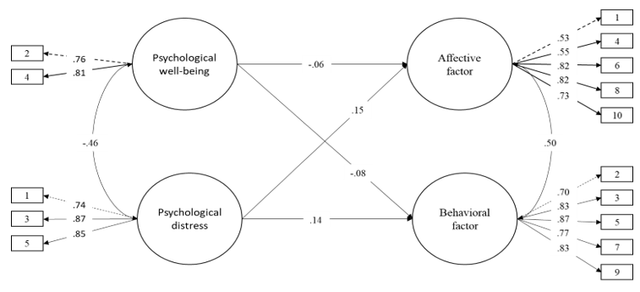
Based on the literature review, an SEM model was proposed to assess the relationship between mental health and social anomie. This study found that the structural model presented adequate fit indices (χ2 = 274.78; df = 84; p = .000; RMSEA = .049 [IC90% .042 – .055]; SRMR = .038; CFI=.98; TLI=.98). In addition, the measurement models are adequately represented by their items since they have high factor weights. It can be observed in Figure 2 that the psychological well-being dimension is not related to the effect (-.06; p > .05) and conduct (-.08; p > .05) dimensions of social anomie. Also, it can be seen that psychological distress does have a significant impact on the affect (.15; p < .05) and conduct (.14; p < .05) dimensions of social anomie.
Figure 2. Predictive model of social anomie
4. DISCUSSION
The present study aimed to study the psychometric properties of the SAS-10 and to evaluate the impact of mental health on social anomie in a community population. The results obtained in the factor structure analysis showed that the two-related factor model shows better psychometric performance than the bifactor model. When comparing a bifactor model with other models, traditional fit indices such as RMSEA, CFI, and TLI tend to favor bifactor models, so evaluating other aspects of the model, such as ECV, PUC, and ARPB, is essential. In the present study, it was shown that the general factor fails to explain the items of the SAS-10 scale sufficiently well; in addition, a greater presence of specific factors was demonstrated (Rodríguez et al., 2016; Domínguez-Lara & Rodríguez 2017). However, this result does not coincide with the initial study of the scale reported in the scientific literature (Vilca, 2022).
This discrepancy could be because the original research focused on an exploratory analysis in which an initial evaluation of the scale's psychometric properties was conducted. In addition, the sample used in this study was considerably larger than in the initial study of the scale; therefore, it had greater statistical power (Arrondo, 2015). It is important to emphasize that the present study sample is mostly women compared to the first study, which was mostly male participants. These differences may have influenced the responses and been reflected in the variations in the results (Díaz-Santos et al., 2008). Likewise, the results could be influenced by contextual factors, such as changes in the regulatory environment, since the original study was carried out amid a pandemic where regulatory restrictions were very present, and new measures had been implemented to stop infections. In contrast, the present study was conducted in the later stages of COVID-19, with a much lower impact (Aranguren & Irrazabal, 2015).
It is important to note that the two-factor model is associated with a previous theory that supports the existence of two distinct but interrelated dimensions, recognizing the multidimensionality of social anomie (Piquero et al., 2002). In addition, this model presents a clear and differentiated internal structure of two constructs since each factor represents a specific dimension of social anomie, allowing a more precise assessment of individuals' experiences regarding affect and behavior related to anomie. Understanding how these factors relate to other constructs (Reise et al., 2013; Marsh et al., 2010) is essential. It also offers a greater explanatory capacity of the variability of the items compared to the Bi-factor model since assigning specific items to each factor makes it possible to capture the unique variability associated with each dimension of social anomie. These results lead to a more complete understanding of the structure of the scale and the relationships between items and factors (Tavakol & Dennick, 2011). Using the two-factor model also facilitates the assessment of the convergent and discriminant validity of the scale. By having two clearly defined factors, it is possible to examine the correlations between items and factors and between the factors themselves. These results provide additional evidence about the factors' internal consistency and ability to measure distinct but related constructs (Rodríguez et al., 2016; Chen et al., 2006).
Regarding the items, in the affective component, item 8, which refers to “I feel annoyed by the new rules and/or laws established by the government,” had the highest factor weight. This result is consistent with the scientific literature since it has been found that displeasure with social norms is associated with a greater rejection of them (Reed & Aquino, 2003). Meanwhile, in the behavioral component, item 5, which refers to “I prefer to break the new rules and/or laws so that my situation does not get worse,” had the highest factor weight. This result coincides with previous studies that mention that people break social norms when they consider that they will obtain economic benefits through these transgressions, thus improving their situation of deprivation (Bicchieri, 2016).
Regarding scale invariance, in the present study, it was found that the SAS-10 scale shows evidence of factorial invariance between men and women. This result means that the factorial structure of the scale is stable and consistent across different population groups, regardless of the participants' sex. Therefore, the SAS-10 scale can be used to measure social anomie in men and women validly and reliably and to make comparisons between both groups (Caycho, 2020). The factorial invariance between age groups was also analyzed (young adults from 18 to 30 years old and young adults from 31 to 68 years old). The results showed that the SAS-10 scale showed evidence of factorial invariance in the two age groups. This means that the underlying structure of the scale is the same in different age groups. Consequently, it is possible to compare social anomie between different age groups (Caycho, 2020). This result is important since previous studies have shown that people's social anomie behavior can change over time (Vera et al., 2013).
Mental health under the dual-factor model (Suldo & Shaffer, 2008) is understood by the absence of psychological distress and the presence of psychological well-being. The psychological well-being component is not related to the components of social anomie (affective and behavioral). On the other hand, the psychological distress component is related to the factors of social anomie. These findings coincide with studies where it is mentioned that well-being would not have a direct impact on the affective or behavioral aspect because people with either high or low levels of well-being may present irrational beliefs, which is why they do not usually manifest anomalous behaviors directly due to their well-being (Jones & Ciarrochi, 2014; Zhang, 2011). Therefore, well-being would not have a determining impact on social anomie at an affective or behavioral level due to the complexity and vulnerability of anomalous behavior to other factors such as stress, personality, and culture, among others factors (Lien et al., 2019; Cano-García et al., 2017; Fosco et al., 2018).
Psychological distress due to unattainable expectations in people would be a factor that significantly impacts anomalous behavior (Jacobsen & Nørup, 2020). Thus, people with high levels of distress are related to a greater probability of going against social norms due to their contempt for them (Merten & Schäfer, 2018). Similarly, psychological distress is a psychological condition that disables people, who tend to be more likely to develop criminal behavior (Kwapil et al., 2008). Regarding reliability, the two-scale dimensions showed adequate levels of internal consistency in the entire sample and the specific sex and age groups. All this evidence guarantees a lower measurement error and greater precision of the scores obtained in the total sample and the specific groups (Valdenegro & González, 2022).
The results of this study must be considered taking into account a set of limitations. First, non-probabilistic sampling was used in data collection. Therefore, the study's results cannot be generalized to the entire population. Second, self-report instruments were applied, which could increase the presence of social desirability in the participants' responses. Third, the study was cross-sectional and limited to a specific geographic area. Therefore, the results cannot be generalized to other areas of Peru, and there is no evidence of the scale's stability over time. Fourth, reliability was estimated only through internal consistency. Therefore, there is no evidence of the stability of the scores over time.
Despite these limitations, the results of the present study show the suitability and robustness of the SAS-10 scale to measure social anomie in a community population, considering specific sex and age groups. Therefore, it could be used for professional practice and research. The number of items in the scale may be handy when a brief and cost-effective measure of social anomie is desired. Brief measures are suitable for online surveys and when respondents have a limited attention span (Caycho-Rodríguez et al., 2024). For all the above reasons, the scale contributes significantly to the advancement of the measurement of social anomie and the understanding of this construct with other variables, such as mental health.
Declarations
Authors' contributions:
RDG, LWV, and TC-R provided initial conception, organization, and main writing of the text. LWV prepared all figures and tables. RDG and LWV were involved in data collection and acted as consultants and contributors to research design, data analysis, and text writing, read and approved the draft.
Conflicts of interest
The author(s) declare(s) that there is no conflict of interest with respect to the research, authorship, and/or publication of this article.
Funding details
The author(s) did not receive financial support for the research, authorship, and/or publication of this article.
Acknowledgments:
Not aplicable
Data availability statement
The database can be freely accessed in the following repository:
https://doi.org/10.17605/OSF.IO/F6RGV
Ethics approval
The study was approved by the ethics committee of the Faculty of Health Sciences of the Peruvian Union University (2022-CE-FCS - UPeU-112). In addition, the study followed the Helsinki standards (World Medical Association, 2013). In addition, informed consent was obtained from all participants.
ORCID iDs
Ricardo D. Gonzales
http://orcid.org/0000-0001-6278-5761
Lindsey W. Vilca
https://orcid.org/0000-0002-8537-9149
Tomás Caycho-Rodríguez
https://orcid.org/0000-0002-5349-7570
References
Abrutyn, S. (2021). Disintegration in the Age of COVID-19: Biological Contamination, Social Danger, and the Search for Solidarity. https://doi.org/10.31235/osf.io/tb538
Arrondo, V. M. (2015). El tamaño de la muestra. Chasqui Revista Latinoamericana de Comunicación, (68), 1-13. http://asignatura.us.es/dadpsico/apuntes/TamMuestra.pdf
Aranguren, M., & Irrazabal, N. (2015). Estudio de las propiedades psicométricas de las escalas de bienestar psicológico de Ryff en una muestra de estudiantes argentinos. Ciencias Psicológicas, 9(1), 73-83. http://www.scielo.edu.uy/pdf/cp/v9n1/v9n1a08.pdf
Barrera, A., Baeza, M., Escandón, N., Constanzo, J., & Escobar, B. (2022). Crisis social chilena y salud mental: Una mirada desde el ciclo vital. Revista de Psicología, 40(1), 241-263. https://doi.org/10.18800/psico.202201.008
Balkin, R. S. (2017). Evaluating evidence regarding relationships with criteria. Measurement and Evaluation in Counseling and Development, 50(4), 264-269. https://doi.org/10.1080/07481756.2017.1336928
Berwick, D. M., Murphy, J. M., Goldman, P. A., Ware, J. E., Barsky, A. J., & Weinstein, M. (1991). Performance of a five-item mental health screening test. Medical Care, 29(2), 169–176. https://doi.org/10.1097/00005650-199102000-00008
Bicchieri, C. (2016). Norms in the wild: How to diagnose, measure, and change social norms. Oxford University Press. https://shre.ink/93Ew
Birbuet, J. C., & López, R. (2020). Dinámica de expansión del COVID-19 en Bolivia durante las primeras 6 semanas. Documento de Trabajo. https://doi.org/10.13140/RG.2.2.19230.69448
Blanco, A., & Díaz, D. (2006). Orden social y salud mental: Una aproximación desde el bienestar social. Clínica y Salud, 17(1), 7-29. https://scielo.isciii.es/pdf/clinsa/v17n1/v17n1a01.pdf
Brenner, M. H., & Bhugra, D. (2020). Aceleración de la ansiedad, la depresión y el suicidio: efectos secundarios de la disrupción económica relacionada con COVID-19. Fronteras en Psiquiatría, 11, 592467. https://doi.org/10.3389/fpsyt.2020.592467
Brown, T. A. (2015). Confirmatory factor analysis for applied research (2a ed.). Guilford Press. https://bit.ly/3YL6dF9
Caycho, T. (2017). Importancia del análisis de invarianza factorial en estudios comparativos en Ciencias de la Salud. Revista Cubana de Educación Médica Superior, 31(2), 1–3. https://www.medigraphic.com/pdfs/educacion/cem-2017/cem172d.pdf
Caycho, A. (2019). Propiedades psicométricas de la escala de anomia social en pacientes drogodependientes peruanos. Revista de Avances en Psicología, 5(1), 17–23. https://doi.org/10.24016/2019.v5n1.164
Caycho Caja, A. (2020). Estructura latente de una escala de anomia social e invarianza factorial en estudiantes peruanos de ambos sexos. Revista de Investigación en Psicología, 23(2), 165–178. https://doi.org/10.15381/rinvp.v23i2.19239
Caycho Caja, A. (2021). Anomia y crisis social en el Perú del bicentenario. Discursos del Sur: Revista de Teoría Crítica en Ciencias Sociales, 7, 165–185. https://doi.org/10.15381/dds.n7.20905
Caycho-Rodríguez, T., Vilca, L. W., Ventura-León, J., Carbajal-León, C., Valencia, P. D., Reyes-Bossio, M., Delgado-Campusano, M., Yupanqui-Lorenzo, D. E., Paredes-Angeles, R., Rojas-Jara, C., Gallegos, M., Cervigni, M., Martino, P., Polanco-Carrasco, R., Palacios, D. A., Moreta-Herrera, R., Samaniego-Pinho, A., Lobos-Rivera, M. E., Buschiazzo Figares, A., … Shulmeyer, M. K. (2023). Test of invariance of the anomie brief scale with the alignment method in 12 Latin American countries. Psychological Thought, 16(2), 349–388. https://doi.org/10.37708/psyct.v16i2.811
Caycho-Rodríguez, T., Vilca, L. W., Ventura-León, J., Valencia, P. D., Carbajal-León, C., Reyes-Bossio, M., Rojas-Jara, C., Polanco-Carrasco, R., Gallegos, M., Cervigni, M., Martino, P., Palacios, D. A., Moreta-Herrera, R., Samaniego-Pinho, A., Lobos Rivera, M. E., Buschiazzo Figares, A., Puerta-Cortés, D. X., Arias Gallegos, W. L., Petzold, O., & Torales, J. (2024). Desarrollo e invarianza transcultural de una medida breve de miedo a la vacuna contra la COVID-19 en 13 países latinoamericanos. Ciencia y Psique, 3(4), 13–54. https://doi.org/10.59885/cienciaypsique.2024.v3n4.01
Cardona, C., Cuba-Borda, P., & Gonzáles-Carrasco, L. E. (2020). Monitoreo en tiempo real del COVID-19 en Bolivia. Documento de Trabajo de CLAPES UC (81). https://cov19bolivia.github.io/doc/COV19Bolivia-Current.pdf
Cano-García, F. J., García-Martín, M. A., Padilla-Muñoz, E. M., & Rodríguez-Franco, L. (2017). Positive psychology and juvenile delinquency: The role of moral efficacy, empathy, and self-control. The Journal of Positive Psychology, 12(4), 336–348. https://doi.org/10.1080/17439760.2016.1221129
Cisneros, J., & Yautentzi, D. (2021). Sobretrabajo en tiempos del Covid-19: Desvelando las jornadas de mujeres en el confinamiento. Journal of the Academy, 4, 6–25. https://doi.org/10.47058/joa4.2
Cueto, C., & Viotti, N. (2020). Pandemic. Prácticas de Oficio. Investigación y Reflexión en Ciencias Sociales, 1(25), 85–101. http://revistas.ungs.edu.ar/index.php/po/article/view/35/29
Chen, F. F., West, S., & Sousa, K. (2006). A comparison of bifactor and second-order models of quality of life. Multivariate Behavioral Research, 41(2), 189–225. https://doi.org/10.1207/s15327906mbr4102_5
Chen, F. F. (2007). Sensitivity of goodness of fit indexes to lack of measurement invariance. Structural Equation Modeling, 14(3), 464–504. https://doi.org/10.1080/10705510701301834
Cronbach, L. J. (1951). Coefficient alpha and the internal structure of tests. Psychometrika, 16(3), 297–334. https://doi.org/10.1007/BF02310555
Dai, W., Meng, G., Zheng, Y., Li, Q., Dai, B., & Liu, X. (2021). The impact of intolerance of uncertainty on negative emotions in COVID-19. International Journal of Environmental Research and Public Health, 18(8), 4189. https://doi.org/10.3390/ijerph18084189
De Sousa Santos, B. (2021). Lecciones iniciales de la pandemia de COVID-19. Revista de Economía Institucional, 23(44), 81–101. https://doi.org/10.18601/01245996.v22n44.05
Díaz-Santos, M., Cumba-Avilés, E., Bernal, G., & Rivera-Medina, C. (2008). Development and psychometric properties of the escala de autoeficacia para la depresión en adolescentes (EADA). Interamerican Journal of Psychology, 42(2), 218–227. https://europepmc.org/article/pmc/6258028
Dominguez-Lara, S., & Rodriguez, A. (2017). Índices estadísticos de modelos bifactor. Interacciones, 3(2), 59–65. https://doi.org/10.24016/2017.v3n2.51
Drury, J., & Stokoe, E. (2022). The interactional production and breach of new norms in the time of COVID-19. British Journal of Social Psychology, 61(3), 971–990. https://doi.org/10.1111/bjso.12513
Fosco, G. M., DeBoard-Lucas, R. L., Grych, J. H., & Raynor, S. R. (2018). Examining the interplay of parental monitoring, parent-adolescent communication, and adolescents’ perceptions of the legitimacy of parental authority. Journal of Family Psychology, 32(2), 230–239. https://doi.org/10.1037/fam0000369
Guerrero, B., & Pérez, A. (2020). Estallido social y pandemia: de los cabildos a las ollas comunes. Espacio Abierto, 29(4), 106–117. https://dialnet.unirioja.es/servlet/articulo?codigo=7738554
Guil Sánchez, J. (2023). Intento de suicidio antes y durante la pandemia de COVID-19. Medicina de Familia. SEMERGEN, 49(3), 101922. https://doi.org/10.1016/j.semerg.2023.101922
Halvaiepour, Z., & Nosratabadi, M. (2021). Identifying social perceptions of people ignoring COVID-19 warnings. BMC Research Notes, 14, 1–5. https://doi.org/10.1186/s13104-021-05797-0
Hancock, G. R., & Mueller, R. O. (2001). Rethinking construct reliability within latent variable systems. Structural Equation Modeling: Present and Future, 195–216, 60–70. https://bit.ly/3Xa8oku
Hernández Freeman, L., Benítez Ávila, I. M., Labarta Varona, M. T., & Almaguer Guerrero, M. R. (2022). Aprendizajes que nos deja la COVID-19. Una mirada sociológica. Estudios del Desarrollo Social: Cuba y América Latina, 10(1), 40–50. http://scielo.sld.cu/scielo.php?pid=S2308-01322022000100004&script=sci_arttext&tlng=pt
Jacobsen, B., & Nørup, I. (2020). Young people’s mental health: Exploring the gap between expectation and experience. Educational Research, 62(3), 249–265. https://doi.org/10.1080/00131881.2020.1796516
Jorgensen, T. D., Pornprasertmanit, S., Schoemann, A. M., & Rosseel, Y. (2018). SemTools: Herramientas útiles para el modelado de ecuaciones estructurales (paquete R versión 0.5-1). https://CRAN.R-project.org/package=semTools
Jones, D. J., & Ciarrochi, J. (2014). Forgiveness and wellbeing: A review and call for future research. The Journal of Positive Psychology, 9(1), 1–23. https://doi.org/10.1080/17439760.2013.837669
Kline, R. B. (2023). Principles and Practice of Structural Equation Modeling (5th ed.). The Guilford Press. https://bit.ly/3YQW8GG
Kwapil, T. R., Barrantes-Vidal, N., & Silvia, P. J. (2008). The dimensional structure of the Wisconsin schizotypy scales. Schizophrenia Bulletin, 34(3), 444–457. https://doi.org/10.1093/schbul/sbm098
Lantz, J. (1986). Family logotherapy. Contemporary Family Therapy, 8(2), 124–135. https://doi.org/10.1007/BF00891874
Lantz, J. E., & Harper, K. (1989). Network intervention, existential depression, and the relocated Appalachian family. Contemporary Family Therapy, 11(3), 213–223. https://doi.org/10.1007/BF00892234
Lantz, J., & Harper, K. (1990). Anomic depression and the migrating family. Contemporary Family Therapy, 12(2), 153–163. https://doi.org/10.1007/BF00892493
Larizgoitia, I., Markez, I., Izarzugaza, I., Páez, D., Mayordomo, S., & Beristain, C. (2004). Impacto en la salud de la violencia colectiva. Norte de Salud Mental, 5(20), 19–28. http://www.ome-aen.org/NORTE/20/NORTE_20_040_19-28.pdf
Lázaro-Aquino, T. G. (2021). Retornantes internos por COVID-19. Socialium, 5(1), 23–36. https://doi.org/10.26490/uncp.sl.2021.5.1.738
León Paz, J., & Vaca, L. (2021). El COVID-19 en el Ecuador. Geopauta, 5(1). https://doi.org/10.22481/rg.v5i1.8173
Lien, N. H., Kim, H. J., & Nam, J. Y. (2019). The relationship between subjective well-being and problem behavior in adolescents. Child Indicators Research, 12(1), 161–177. https://doi.org/10.1007/s12187-018-9525-5
Linn, J. G., Alencar, A., Arredondo, E., Wilson, D. R., & Sommers, G. (2021). COVID-19 y el acceso a los servicios de salud en Chile. Figshare. https://doi.org/10.6084/m9.figshare.17087291.v1
Marsh, H. W., Lüdtke, O., Muthén, B., Asparouhov, T., Morin, A. J. S., Trautwein, U., & Nagengast, B. (2010). A new look at the big five factor structure. Psychological Assessment, 22(3), 471–491. https://doi.org/10.1037/a0019227
Madariaga, C. (2019). El “estallido social” y la salud mental de la ciudadanía. Revista Chilena de Salud Pública, 23(2), 146–156. https://doi.org/10.5354/0719-5281.2019.56475
Merten, J., Krauss, S., & Schäfer, S. (2018). From anomie to anxiety. Personality and Individual Differences, 131, 198–203. https://doi.org/10.1016/j.paid.2018.04.012
McDonald, R. P. (1999). Test theory: A unified treatment. Taylor & Francis. https://doi.org/10.4324/9781410601087
Narváez, N. C., & Acosta-Ramírez, N. (2022). Calidad de vida percibida y morbilidad materna extrema. Ciência & Saúde Coletiva, 27, 1703–1712. https://doi.org/10.1590/1413-81232022275.24032021
Powell, R. A., Kendall, K., Cislaghi, B., & El-Osta, A. (2021). Self-care, social norms and anomie during COVID-19. Journal of Epidemiology & Community Health, 75(10), 925–926. https://doi.org/10.1136/jech-2021-217292
Rodríguez, A., Reise, S. P., & Haviland, M. G. (2016). Applying bifactor statistical indices. Journal of Personality Assessment, 98(3), 223–237. https://doi.org/10.1080/00223891.2015.1089249
Saletti-Cuesta, L., & Aizenberg, L. (2022). Abordajes de violencias de género y de interrupción legal del embarazo en servicios de salud durante el aislamiento por COVID-19. Salud colectiva, 17, e3678. https://doi.org/10.18294/sc.2021.3678
Sijtsma, K. (2009). On the use, the misuse, and the very limited usefulness of cronbach’s alpha. Psychometrika, 74(1), 107-120. https://doi.org/10.1007/s11336-008-9101-0
Suldo, S. M., & Shaffer, E. J. (2008). Looking beyond psychopathology: The dual-factor model of mental health in youth. School Psychology Review, 37(1), 52–68. https://doi.org/10.1080/02796015.2008.12087908
Schumacker, R. E., & Lomax, R. G. (2004). A beginner´s guide to structural equation modeling (2nd ed.). Psychology Press. https://shre.ink/a6dl
Tavakol, M., & Dennick, R. (2011). Making sense of cronbach’s alpha. International Journal of Medical Education, 2, 53-55. https://doi.org/10.5116/ijme.4dfb.8dfd
Valencia León, I. T. (2021). Covid-19 y el Perú. Efectos del aislamiento social obligatorio en los inmigrantes extranjeros. Espiral, Revista de Geografías y Ciencias Sociales, 2(4), 33–52. https://doi.org/10.15381/espiral.v2i4.19531
Valdenegro Fuentes, L., & González Sanzana, Á. (2022). Propiedades psicométricas de la escala de medida de la identidad docente. Revista Brasileira de Educação Especial, 28, e0036. https://doi.org/10.1590/1980-54702022v28e0036
Vilca LW, Gonzales RD, Pariona-Millán V, Caycho-Rodríguez T, White M. (2022). Development and validation of the social anomie brief scale (SAS-10) against the new standards implemented during the COVID-19 pandemic. Electron J Gen Med, 19(3), em375. https://doi.org/10.29333/ejgm/11911
Vilca, L. W., Chávez, B. V., Fernández, Y. S., & Caycho-Rodríguez, T. (2022). Spanish version of the revised mental health inventory-5 (R-MHI-5): New psychometric evidence from the classical test theory (CTT) and the item response theory perspective (IRT). Trends in Psychology, 30(1), 111-128. https://doi.org/10.1007/s43076-021-00107-w
Vera Noriega, J. Á., Camino, C., Formiga, N. S., Yañez Quijada, A. I., & Bautista, G. (2013). Propiedades psicométricas de anomia, alienación y desarrollo moral en estudiantes de bachillerato. PSICO, 18(2), 231–240. https://doi.org/10.1590/s1413-82712013000200007
Viladrich, C., Angulo-Brunet, A., & Doval, E. (2017). A journey around alpha and omega to estimate internal consistency reliability. Anales de Psicología, 33(3), 755–782. https://doi.org/10.6018/analesps.33.3.268401
Villegas, D. (2020). Influencia del contexto familiar desintegrado sobre la anomia social. Politécnico Gran Colombiano, 2(2). https://journal.poligran.edu.co/index.php/encuentros/article/view/2659/2755
World Medical Association. (2013). World medical association declaration of helsinki: Ethical principles for medical research involving human subjects. JAMA, 310(20), 2191–2194. https://doi.org/10.1001/jama.2013.281053
Zinbarg, R. E., Revelle, W., Yovel, I., & Li, W. (2005). Cronbach’s α, revelle’s β, and Mcdonald’s ωH: Their relations with each other and two alternative conceptualizations of reliability. Psychometrika, 70(1), 123–133. https://doi.org/10.1007/s11336-003-0974-7
Zhang, Y. (2011). Relationship between subjective well-being or irrational beliefs and aggressive behavior tendency among college students. Chinese Journal of School Health, 7, 803–805. https://www.semanticscholar.org/paper/Relationship-between-subjective-well-being-or-and-Yu-yin/245ca5a842035735ba3c3ead3ffa565bd2f5ce1e
-
 Este artículo es de acceso abierto distribuido bajo los
términos y condiciones de la Licencia Creative Commons
Attribution (CC BY)
(https://creativecommons.org/licenses/by/4.0/)
Este artículo es de acceso abierto distribuido bajo los
términos y condiciones de la Licencia Creative Commons
Attribution (CC BY)
(https://creativecommons.org/licenses/by/4.0/)
- Cómo citar: Gonzales RD, Vilca LW, Caycho-Rodríguez T. “New evidence on the psychometric performance of the Brief Social Anomie Scale (SAS-10) in post-pandemic Peruvian adults”, Avances en Psicometría Iberoamericana (API), vol. 1, Diciembre 2025 https://doi.org/10.26495/rtjrxe46